Epoxy vs. polyaspartic for garage floors
Short answer: epoxy is often lower in cost and builds a thick film; polyaspartic cures faster and holds its color in sunlight. Many garages use both. The right choice depends on your slab, timeline and budget.
Side-by-side comparison
| Factor | Epoxy | Polyaspartic |
|---|---|---|
| Return to service | Slower. Foot traffic can be about a day; vehicles are often kept off for several days. | Faster. Vehicles can often return within a day or two. |
| Sunlight / color | Can yellow or "amber" in direct sunlight; a UV-resistant topcoat may not fully prevent it. | Generally UV-stable and non-yellowing. |
| Application temperature | More temperature-sensitive; 50°F is a common minimum. | Some products allow much colder application. Check the data sheet. |
| Moisture in the slab | Also affected by moisture; some systems include a moisture primer. | Poorly suited to slabs with active moisture vapor transmission. |
| Upfront cost | Often lower. | Often higher. |
| Working time | Longer; some consumer kits exist. | Short; usually professional-installed. |
| Film build | Can be built thick to hide minor flaws. | Usually applied thinner, often as a topcoat. |
| Hot-tire resistance | Varies by formulation. | Often recommended where hot-tire marks are a concern; one data sheet says its product is hot-tire resistant after 48 hours. |
Sources: The Concrete Network for the general comparison;1 manufacturer data sheets for the figures.23
Two manufacturer data sheets, side by side
These are two specific products, shown only to illustrate how much figures vary by product. Other products, temperatures and thicknesses give different numbers, and your provider's data sheet governs.
| Item | Sikafloor-264 (pigmented epoxy) | SurfaceOne 97% clear polyaspartic |
|---|---|---|
| Foot / light traffic | About 12 hours foot traffic and about 2 days light traffic at 68°F | Light pedestrian traffic after 2 to 4 hours (tack-free in 1 to 2 hours at 75°F and 50% RH) |
| Vehicles / full cure | Full cure about 7 days at 68°F (about 10 days at 50°F) | 24 to 48 hours for vehicle traffic; hot-tire resistant after 48 hours |
| Application temperature | 50 to 85°F ambient and substrate; substrate at least 5°F above the dew point | Best suited to -10 to 85°F |
| Slab moisture limit | At most 4% by mass (meter reading); at most 85% RH by ASTM F2170 | 3 lb per 1,000 sq ft per 24 hours by ASTM F1869; under 4% by impedance meter |
| Sunlight | "Will discolor over time when exposed to sunlight (UV)" | Described as UV stable and non-yellowing |
| Who applies it | "May only be used by experienced professionals"; working time about 25 minutes at 68°F | Not stated on the sheet; diamond grinding is recommended |
How soon can I park on it?
It depends on the product, thickness and temperature. Colder slabs cure slower: the epoxy sheet above lists about 24 hours to foot traffic and 10 days to full cure at 50°F, versus 12 hours and 7 days at 68°F. Ask your provider for the written return-to-service time for foot traffic and for vehicles, and what changes if the weather turns cold.
What about hot-tire pickup and slipperiness?
Hot-tire pickup is when warm tires lift or mark a coating. Polyaspartic topcoats are often recommended where it is a concern,1 and manufacturers publish when their product is considered hot-tire resistant (48 hours on the polyaspartic sheet above). Smooth, glossy floors can be slippery when wet. Flake adds texture, and manufacturers offer slip-resistant versions with an additive; ask the provider what traction the system will have.3
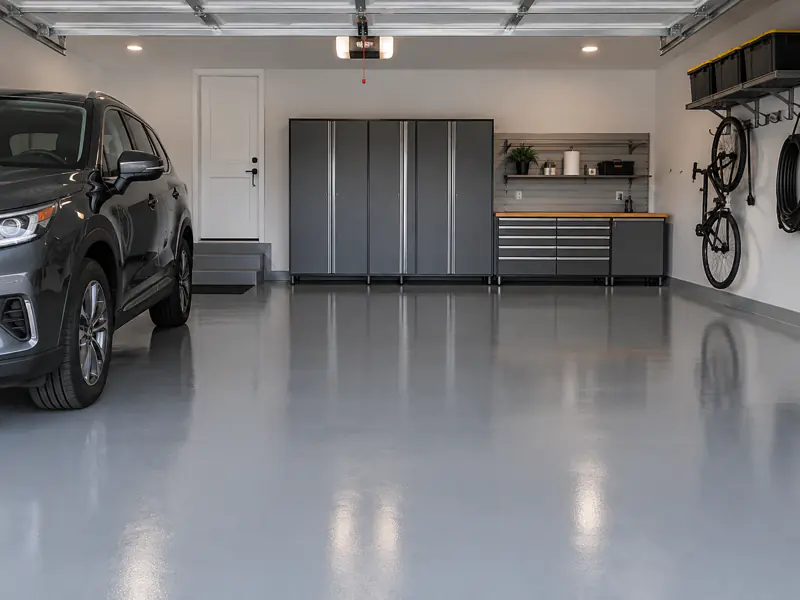
What a smooth solid-color finish looks like
Solid-color systems give a uniform, glossy surface. Flake systems add texture and hide more imperfections. Both can be topcoated for protection.
The hybrid approach
Many systems combine both: an epoxy base coat for build and coverage, with a polyaspartic topcoat for UV stability and wear. This can balance cost and durability, but it depends on the slab's moisture condition and the products used.
Which fits which situation?
Epoxy may fit when…
- Budget is the priority
- The floor gets little direct sun
- You can wait several days before parking
- The slab has minor surface flaws to hide
Polyaspartic may fit when…
- You need the garage back quickly
- Sunlight reaches the floor
- Hot-tire marks are a concern
- The slab passes moisture testing
Questions to ask any provider
- Which exact products and how many coats will you use?
- How will you prepare the surface and test for moisture?
- How long until foot traffic and until vehicles, at today's temperature?
- What does the written warranty cover, and for how long?
To compare how each contractor answers these, see the questions about coating systems in our hiring guide and the comparison checklist.
Get My Free Pricing Assistance
Sources
- The Concrete Network, What's the Best Concrete Garage Floor Coating? General industry education.
- Sika Corporation, Sikafloor-264 Product Data Sheet (September 2026, version 08.05): cure table, 50–85°F application limits, dew-point rule, moisture limits, UV note, professional-use statement.
- SurfaceOne, 97% Solid Clear Polyaspartic Technical Data Sheet (distributor-hosted copy): traffic times, temperature range, moisture limits, hot-tire and slip-resistance notes.
Last reviewed: 2026-10-14
Want help getting a better price on your garage floor?
Tell us about your garage in about two minutes. Our help is free, and we follow up personally.
Topeka Garage Floors (TopekaEpoxy.com) is an independent referral and negotiation-assistance service operated by It's Just Local. We are not a contractor, and contractors may compensate It's Just Local for qualified referrals. Availability and final pricing are subject to confirmation. How it works