Garage floor preparation and common problems
Preparation decides whether a coating lasts. This guide covers what good prep includes, what to do about cracks and old coatings, and what to ask a provider.
What good surface preparation involves
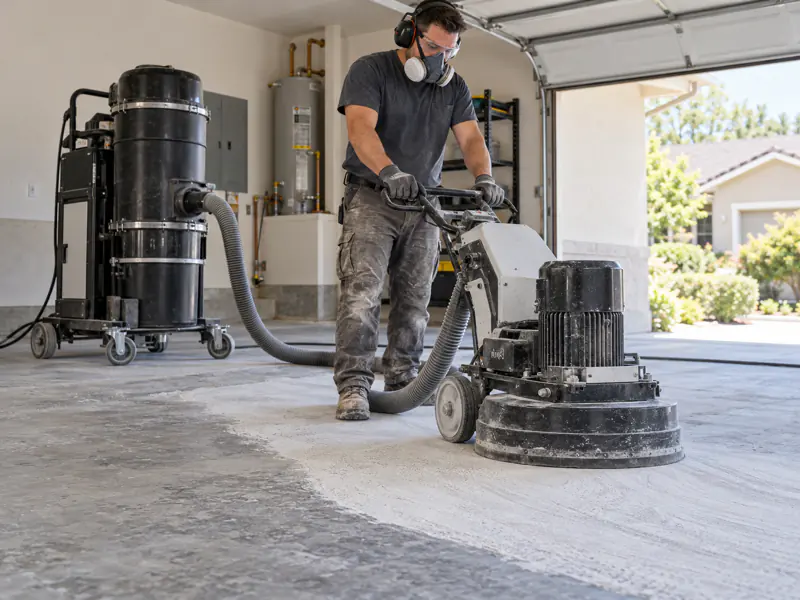
- A mechanical profile. Coatings need a roughened surface to grip. Diamond grinding and shot blasting are the usual methods, and the target roughness is described with the ICRI Concrete Surface Profile (CSP) scale. The epoxy data sheet cited below calls for a profile equivalent to ICRI CSP 3 to 4.12
- Acid etching is not a substitute for checking the product's requirements. Some manufacturers publish an acid-etch procedure for their own products, while others call for grinding or blasting. Etching does not remove chemical curing compounds, which must be removed mechanically or chemically before coating.3 Ask which method the product requires.
- Contamination removed. Oil, grease, sealers and old coatings can stop a new coating from bonding.
- Cracks, joints and spalls repaired with products compatible with the coating (see below).
- Dust removed before any coating is applied.
Can cracked concrete be coated?
Often yes, after repair, but it depends on the crack. Hairline cracks that do not move are typically filled with a compatible filler before coating. Moving ("dynamic") cracks and joints are different: one manufacturer bulletin calls for a flexible polyurethane sealant for dynamic cracks or joints wider than 1/4 inch.3 Wide cracks, heaving or settlement can point to a structural or drainage problem that a coating cannot fix, and should be evaluated first.
Can you coat over an existing coating or paint?
Only if the old coating is sound. Peeling or poorly bonded coatings are normally removed, sometimes by abrasive blasting, and a tape test over cut lines is a common check: if large pieces come off, more preparation is needed.3 Ask your provider how they will test adhesion on your floor.
Does the slab have a moisture problem?
Moisture coming up through the slab is a leading cause of blistering and delamination. Common test methods include:
| Test | What it is | Commonly cited threshold |
|---|---|---|
| Plastic sheet (ASTM D4263) | A sheet is taped to the floor for 16 to 24 hours; condensation or darkening suggests moisture. A screening check only. | No numeric result |
| Calcium chloride (ASTM F1869) | Measures moisture vapor emission from the surface over about 60 to 72 hours. | Many manufacturers: under 3 lb per 1,000 sq ft per 24 hours |
| In-slab relative humidity (ASTM F2170) | Probes placed in drilled holes read humidity inside the slab. | Often under about 80% RH; one epoxy data sheet allows up to 85% |
Limits are product-specific, and the data sheet governs. Sources disagree about which method is most reliable.452
New concrete. A 28-day cure is commonly treated as a minimum guideline before coating, and some moisture-tolerant products allow earlier application. Ask the provider what the product requires.5
When is the best time to coat in Topeka?
Data sheets set the limits, not the calendar. The epoxy sheet cited here requires 50 to 85°F for both the air and the slab, with the slab at least 5°F above the dew point; the polyaspartic sheet says its product is best suited to -10 to 85°F.26 NOAA's 1991–2020 normals for Topeka (Forbes Field) show about 119 days a year with lows at or below freezing, a January average low near 19°F and a July average high of 90°F.7 In an unheated garage, that means cold months can fall below some products' limits and summer afternoons can exceed them, so ask how the provider manages temperature, humidity and curing time for your project, and whether the garage will be heated or conditioned.
Common problems and likely causes
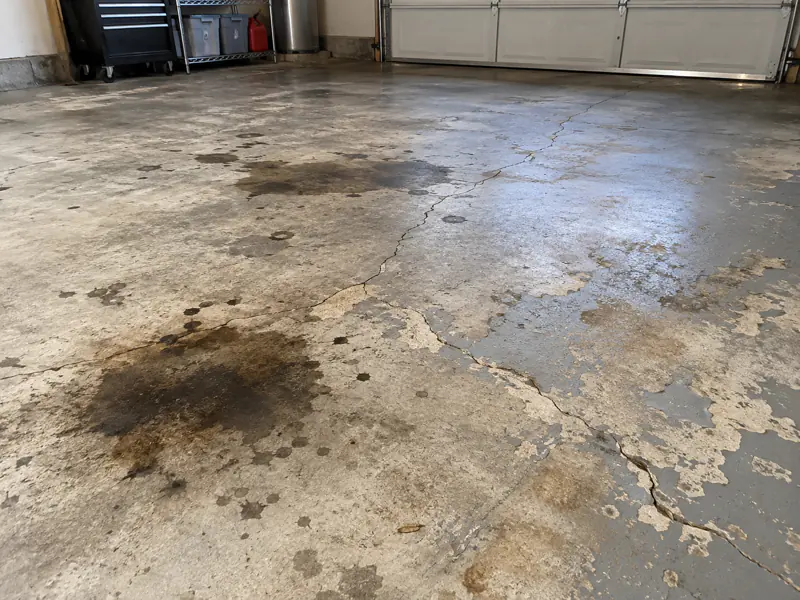
- Peeling or flaking: poor surface preparation, contamination, moisture, or an incompatible product.
- Bubbles or blisters: trapped moisture vapor, solvent or air, or applying a moisture-sensitive coating too soon.
- Yellowing or amber tint: UV exposure on a coating that is not UV-stable.
- Hot-tire pickup: warm tires lifting the coating; formulation and cure time matter.
- Slippery when wet: a smooth topcoat; ask about anti-slip additives.
- Cracks returning: moving cracks can reflect through a coating; coating does not stop slab movement.
Getting your garage ready
- Plan to empty the garage, including shelving and wall-mounted items near the floor.
- Ask where vehicles will be parked and for how many days.
- Ask about ventilation, odors, and keeping pets and children out.
- Note existing oil stains, old coatings and cracks, and take photos for the provider.
- Confirm access to power and water, if needed.
More questions to ask about preparation, dust control and moisture testing are in the contractor hiring guide.
Get My Free Pricing Assistance
Sources
- Concrete Decor, Surface prep critical for all concrete jobs (CSP scale overview).
- Sika Corporation, Sikafloor-264 Product Data Sheet (September 2026, version 08.05): CSP 3–4, 50–85°F, dew point, moisture limits. One epoxy product, cited as an example.
- Diamond Vogel, Concrete surface preparation for floor coatings (technical bulletin): etching and blasting procedures, curing compounds, cracks and joints, removal of existing coatings. Procedures are specific to that manufacturer's products.
- AMPP, Concrete moisture testing and mitigation.
- Sherwin-Williams, How soon can you epoxy coat freshly poured concrete?
- SurfaceOne, 97% Solid Clear Polyaspartic Technical Data Sheet (distributor-hosted copy).
- NOAA NCEI, U.S. Climate Normals 1991–2020, station USW00013920 (Topeka Forbes Field), monthly normals: days with minimum temperature at or below 32°F summed over the year (about 119), January normal low 18.8°F, July normal high 90.0°F.
Last reviewed: 2026-10-14
Want help getting a better price on your garage floor?
Tell us about your garage in about two minutes. Our help is free, and we follow up personally.
Topeka Garage Floors (TopekaEpoxy.com) is an independent referral and negotiation-assistance service operated by It's Just Local. We are not a contractor, and contractors may compensate It's Just Local for qualified referrals. Availability and final pricing are subject to confirmation. How it works